


A Multicultural Wedding Venue in Italy: How Bangladesh and Ireland Met in an Umbrian Castle
Some of the best questions I receive start the same way: "We love Italy, but our wedding isn't only Italian. Can you actually do this?"
A couple wants a mehndi on the first night and a black-tie dinner on the second. Another wants a tea ceremony at eleven in the morning and a dance floor at two in the morning. A third wants a menu their grandmother would approve of, in a country famous for a completely different cuisine. They are not asking whether Italy is beautiful. They are asking whether a venue can hold two cultures in one weekend without either of them feeling like a guest.

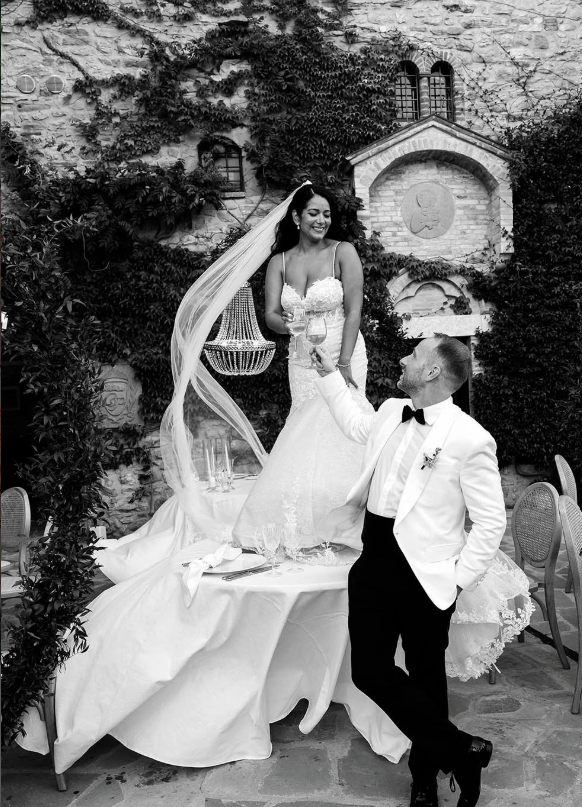
This summer we hosted a wedding that answers that question better than anything I could write in the abstract. Zarah, from London with Bangladeshi heritage, and Jack, who is Irish, married here in June. Their celebration was featured in Together Journal, photographed by Cybele Buffile, and Zarah described the castle as "the beating heart of the wedding." This is what it looked like from my side of it, and what it taught me about what a multicultural wedding venue in Italy actually needs to offer.
What a Multicultural Wedding Venue in Italy Has to Do
Before the story, the practical frame. A wedding that carries two traditions asks six things of a property, and most beautiful venues can only provide three or four.
It needs several distinct spaces, because each event has its own mood and cannot happen in the same corner as the one before. It needs a kitchen and a team willing to work outside their own culinary tradition. It needs enough days: a fusion celebration is never a single evening. It needs sound and space for live musicians from more than one tradition, sometimes on the same day. It needs accommodation, because guests travelling from two countries cannot be scattered across hotels. And it needs staff who have done this before and will not be surprised by a dhol drum at sunset or a ceremony that runs on a different rhythm.
Zarah and Jack tested all six.
The Welcome Party That Was a Mehndi
The mehndi is a South Asian pre-wedding celebration built on food, music and dancing, and it was the first event of their weekend. Both the bride's and the groom's parties had taken dance lessons and learned separate choreographies, which they performed that night. A dhol player carried the rhythm, and the whole thing unfolded on our terrace as the sun went down over the Umbrian valley. Zarah later said it felt cinematic, and she was right.
I will admit something here: I ended up as the DJ for that party. It was one of the most enjoyable evenings I have had at my own castle in sixteen seasons.
What made it work was not improvisation. It was space. The terrace where the welcome party took place is not the courtyard where they later had dinner, and neither is the garden where they married. When each event has its own setting, a mehndi does not have to compete with a black-tie dinner for the same stones and the same lights.
An Irish Processional in an Umbrian Garden
The second tradition arrived the next day. Zarah and Jack brought over The Shire, an Italian band that plays traditional Irish music, and gave them a list of Irish songs. Those were the songs playing as Zarah walked down the aisle, in a garden in Umbria, to a groom whose family had come from Ireland and Spain.
That is the detail I would show any couple wondering whether a multicultural wedding venue in Italy can really hold their story. Nothing about the setting was altered. The castle was still a 14th-century castle in the Umbrian hills. But the music was theirs, the first night had been Bangladeshi, and the dress code that evening was black tie. Three identities, one weekend, no compromise between them.
Why a Multicultural Wedding Venue Needs Several Spaces, Not One Perfect View
When Zarah explained what made the venue work for them, she pointed at exactly this: the property had many different spaces, so different parts of the wedding could happen in different settings, which gave the weekend a natural flow and let each moment feel distinct.
I would underline that sentence for every couple planning a multi-cultural or multi-day celebration. A single spectacular terrace is a photograph. A property with five or six usable settings is a schedule.
Here that means a terrace facing Assisi for ceremonies, a second terrace for welcome parties, a stone courtyard for dinner, a covered Limonaia for dancing until four in the morning, gardens and a pool for the daytime, and thick-walled cellars underneath for heat or rain. Couples with one event need one beautiful space. Couples with five events need five, and they need them close enough to walk between in evening shoes.
They also visited in winter, when the gardens were bare, and came back in June to find everything in bloom. If you are choosing a venue off-season, ask to see photographs from the month of your wedding. The same place can look like two different properties.
The Kitchen Question Every Multicultural Couple Should Ask
Food was where Zarah and Jack chose to spend. They wanted plenty of it, and they wanted it to be memorable. Our kitchen is run by my brother Luca, and by the end of the weekend their guests were telling them it was the best food they had ever eaten at a wedding. The detail that delighted them most was the late-night snack: cacio e pepe, served well after midnight.
But here is the honest advice, which goes beyond our case. If your menu has to reflect another culture, ask the venue three specific questions before you book. Can your kitchen cook these dishes, and have you done it before? If not, will you allow an outside chef or caterer to use your kitchen, and under what conditions? And can you handle the dietary rules that come with our families, whether that is halal, vegetarian, no beef, no pork or no alcohol at certain events?
A venue that answers those three questions clearly is a venue you can plan with. One that answers vaguely will become a problem eight months later, and by then your deposit is gone.
Two Wardrobes, Three Days, One Suitcase Problem
A fusion wedding doubles the wardrobe. Zarah wore a lehenga for the mehndi and welcome party, built around a veil she found first in a small shop in London, and a modern two-piece corset and skirt by Seraphine for the wedding day. Jack wore a tuxedo he had fitted with his father, who came over from Spain for the occasion.
These are not only fashion notes. They are logistics. Two or three outfits per person, often heavily embroidered and impossible to fold, mean that bedrooms need space and hanging room, that someone needs to press garments on site, and that the getting-ready suites are occupied for longer than in a single-ceremony wedding. When you visit a venue, look at the rooms with this in mind, and ask who will iron what, and when.
Planning a Multicultural Wedding in Italy: What to Ask a Venue
From our side of these weekends, these are the questions that actually predict whether it will work:
How many separate spaces can we use, and how far apart are they?
Can we hold three or four events across three days, and what does each day cost?
Has your team hosted a mehndi, sangeet, tea ceremony or equivalent before?
Will your kitchen cook our cultural menu, or can we bring a specialist chef?
How do you handle halal, vegetarian, no-alcohol or other dietary requirements?
Can we bring our own musicians, and is there power and sound support for them?
Until what time can music play, indoors and outdoors?
How many of our guests can sleep on the property, and how many rooms have space for elaborate outfits?
What is the indoor alternative for each event if the weather turns?
Who from your team will be present at every event, not only at the wedding?
The Team Behind This Wedding
Photography was by Cybele Buffile, with her team Domi and Carlos, and film by Oh My Day Studio. Planning was by my sister, Giorgia Landrini, here at Castello di Petrata, who guided Zarah and Jack from their first enquiry through three days of events. Florals, stationery and signage were designed by Luisa Gervasi, whose brief was that the flowers should look as though they had grown out of the landscape rather than been placed on it. Music came from a dhol player and from The Shire, the Irish band. Catering and the wedding cake came from our own kitchen, led by Luca Landrini. The full feature, with Cybele's photographs, is on Together Journal.
Frequently Asked Questions
Can you have a mehndi or sangeet at a wedding venue in Italy?
Yes, and it works best at an exclusive-use property with several separate spaces, so the celebration has its own setting rather than borrowing the wedding-day one. At Castello di Petrata a mehndi typically takes place on a terrace on the arrival evening, with live musicians, dancing and dinner, and runs on its own timeline.
Can an Italian wedding venue cook South Asian or halal food?
It depends entirely on the venue, which is why you should ask before booking. Some properties with in-house kitchens will cook a cultural menu themselves, some will allow an outside specialist chef to use the kitchen, and some will do neither. Ask the question in those exact terms, and ask whether they have done it before.
How many days do you need for a multicultural wedding in Italy?
Usually three at minimum: a pre-wedding celebration such as a mehndi or welcome party, the wedding day itself, and a farewell event. Couples combining two traditions often use four, because each family's key ritual deserves its own evening rather than being compressed into the wedding day.
Can we bring our own musicians from home?
Yes. Guest couples regularly bring dhol players, Irish and Greek bands, DJs and singers from their own country. What matters is that the venue can provide power, sound support and an appropriate space, and that any music licensing fees in Italy are handled — ask the venue who files them.
What makes a good multicultural wedding venue in Italy?
Several distinct spaces close enough to walk between, on-site accommodation so both families stay together, a kitchen willing to work outside Italian tradition, staff who have run multi-event weekends before, indoor alternatives for every event, and flexibility on timings, since cultural ceremonies rarely fit a standard Italian schedule.
Can both families stay at the venue?
At a property with accommodation, usually yes. Castello di Petrata has 22 rooms and suites sleeping up to 55 guests, which for a multi-day celebration matters more than usual: relatives meeting for the first time share breakfasts and pool afternoons, not just a dinner table.
Do we need a wedding planner for a fusion wedding in Italy?
Yes. A multi-day, multi-tradition wedding has more moving parts than any other format, and someone has to hold the timeline across every event. In this case the planning was done in house by our own team, which meant the planner, the kitchen and the venue were the same people, with nothing lost between them.
Planning a celebration that carries more than one tradition? Write to me at info@castellopetrata.com and tell me about your events — I will tell you honestly how they would work here.
Giovanni Landrini is the owner and director of Castello di Petrata, a 14th-century castle near Assisi that has hosted international weddings since 2010. Read more about Giovanni.


Betting Insider was useful when I wanted to compare different bookmakers. The page has a simple structure, and the information https://betting-insider.com/it/casino/bonus/ is organized in a way that is easy to understand. I did not have to browse through many sections to find what I needed. Everything felt clear and convenient, which made the research process much quicker and more comfortable